August 20, 2026
Design for Deconstruction: Social Justice Implications of Circular Construction
ARC Fellow: Idris Soliu
Degree Program: PhD. Built Environment
Faculty Advisors: Catherine De Almeida (Landscape Architecture)
Firm: ZGF
Firm Advisors: Lona Rerick
Project dates: Autumn 2024 – Spring 2025
Read the Project Report
Click to Watch the Presentation
Click to View the Presentation Slides
More about the project:
Construction and demolition waste from the standard linear (take-make-use-dispose) approach often ends up in landfills, usually in marginalized communities. This business-as-usual practice of construction waste management disproportionately affects underrepresented groups through environmental hazards and economic exclusion, thereby contributing to social inequality. In contrast, Design for Deconstruction (DfD) has the potential to be a circular economy strategy that balances building design with future disassembly, promotes material reuse and reduces landfill waste, and potentially positively impacts social justice outcomes. This project explores how DfD can facilitate social justice in managing construction and demolition waste within the built environment through circular building design. Ten DfD principles were initially identified from the literature, followed by case studies where these principles were previously applied, as well as the barriers to implementing the principles in construction projects. This study employed a mixed research approach by integrating case studies and a cross-sectional survey of design and construction firms with experience in demolition and deconstruction projects. The results uncovered interchangeability and repairability, material specification, and design with workers in mind as the top DfD principles currently being implemented by construction industry practitioners based on the ten principles investigated. The findings also found that the high cost of deconstruction and the absence of policy support were the most critical barriers hindering the DfD in the Pacific Northwest construction market. The study concludes with frameworks for waste diversion for new and existing buildings to mitigate the impact of current practice and achieve a sustainable built environment.
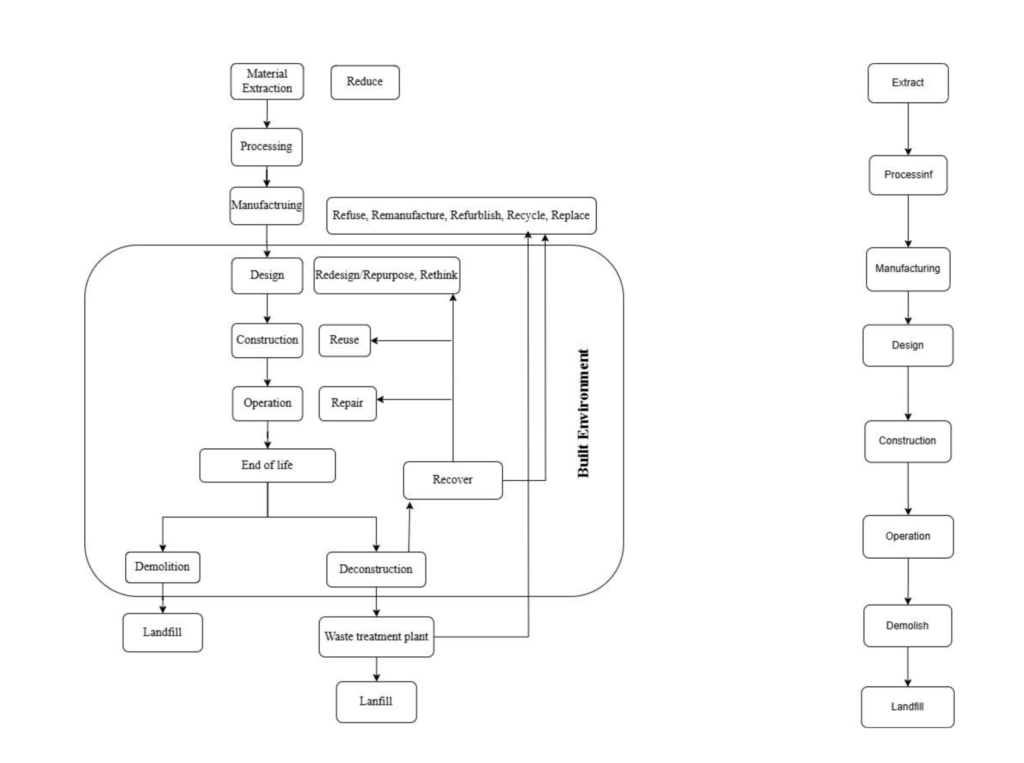
Illustration of material circularity enabled by Design for Deconstruction in the built environment. The graphic contrasts two pathways: designing for deconstruction versus designing for demolition, and highlights material flow from extraction through to the end-of-life stage. IDRIS SOLIU
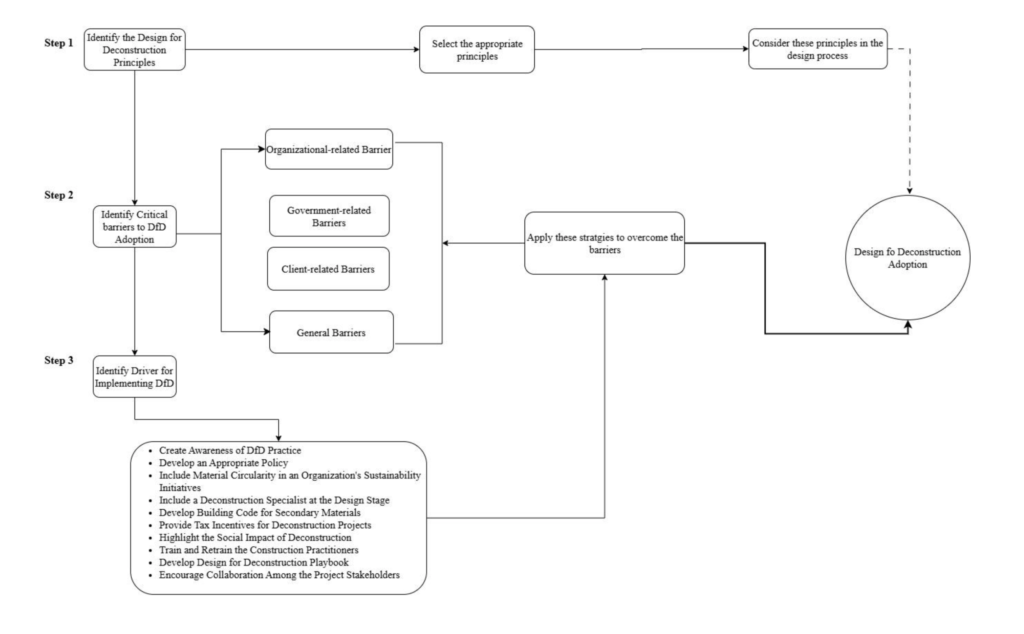
A three-step framework outlining the implementation of Design for Deconstruction in construction projects. The flowchart presents the core Design for Deconstruction principles, identifies common barriers, and emphasizes key drivers that facilitate industry adoption. IDRIS SOLIU
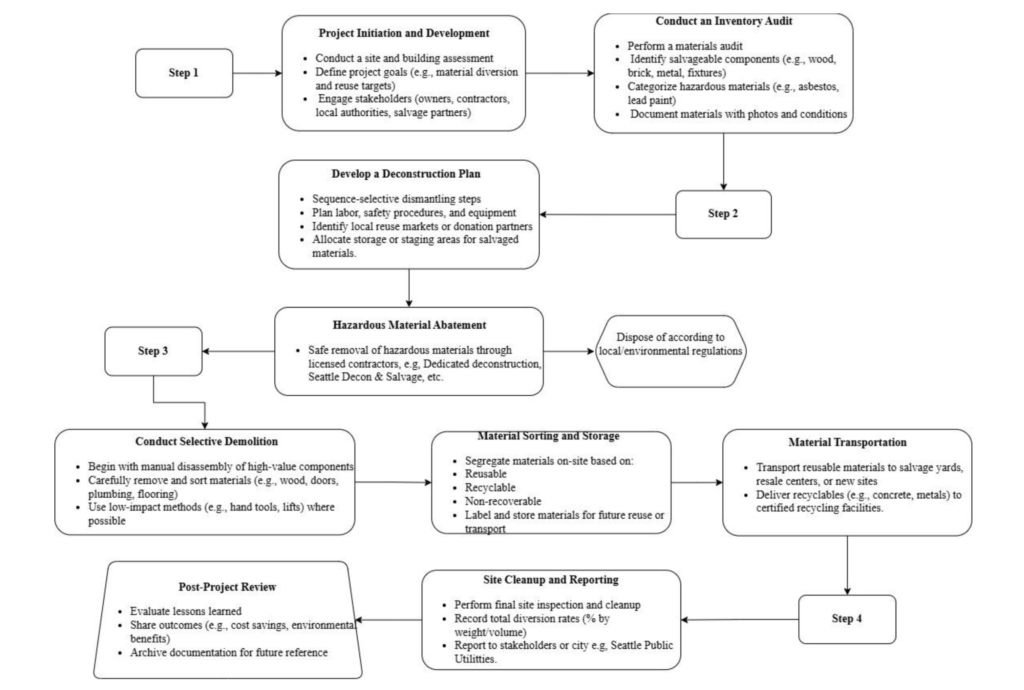
Step-by-step process for deconstructing existing structures using Design for Deconstruction principles. The diagram highlights critical deliverables and actions at each stage of the building deconstruction lifecycle, which align with circular economy objectives. IDRIS SOLIU
