August 20, 2026
An Resilience Research Platform: Streamlining the Resiliency Research Workflow for Architecture Teams
ARC Fellow: Yongqin Zhao
Degree Program: PhD in the Built Environment
Faculty Advisors: Tzu-Hsin Karen Chen
Firm: ZGF
Firm Advisors: Flavia Gray
Project dates: Autumn 2024 – Spring 2025
Read the Project Report
Click to Watch the Presentation
Click to View the Presentation Slides
More about the project:
Resilience to extreme weather and natural disasters is vital in healthcare architecture—protecting lives, budgets, and operations for clients, users, and designers alike, from the societal scale down to the individual site. Despite the availability of many resources, the integration of resilience in current design practice remains limited. In response, this research explores how the project team can more effectively utilize available resources to thoughtfully and strategically be best informed in the resilience design research process. Based on a review of current literature, resources, and a detailed survey and in-depth workshops, this study proposes an essential workflow that addresses the limitations of several existing frameworks. The tasks within the essential workflow are designed precisely for use cases at the early design phase. Then, based on the essential workflow, a web-based platform is developed, providing architectural design teams with a more accessible and friendly approach to streamline the resilience design research workflow: identifying the specific concern, assessing risk and vulnerability, and navigating resilience-related resources. This study delivers the first lightweight, task-oriented workflow that unifies dispersed resilience data, tools, and precedents within a single, designer-friendly platform. By mapping resources directly to early-phase tasks, the platform gives project teams—and the wider resilience community—an accessible hub for rapid, structured inquiry. Methodologically, the work introduces a Retrieval-Augmented Generation (RAG) approach tailored to AEC design tasks, demonstrating how bespoke, in-house AI applications can streamline niche workflows and open a new direction for building-design technology
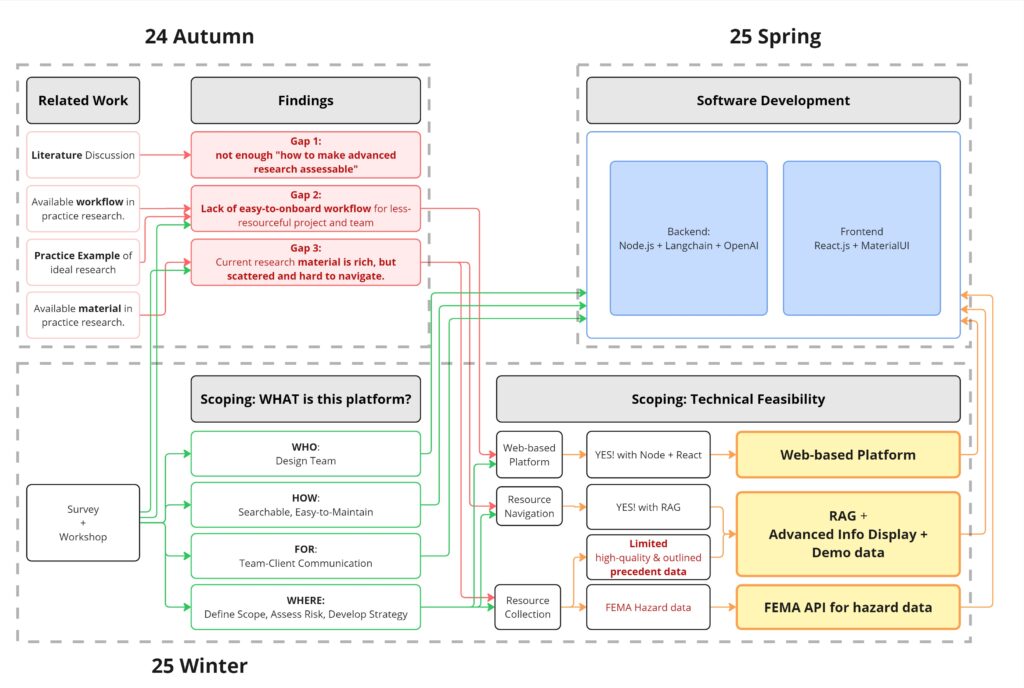
Research timeline and framework through three phases. YONGQUIN ZHAO
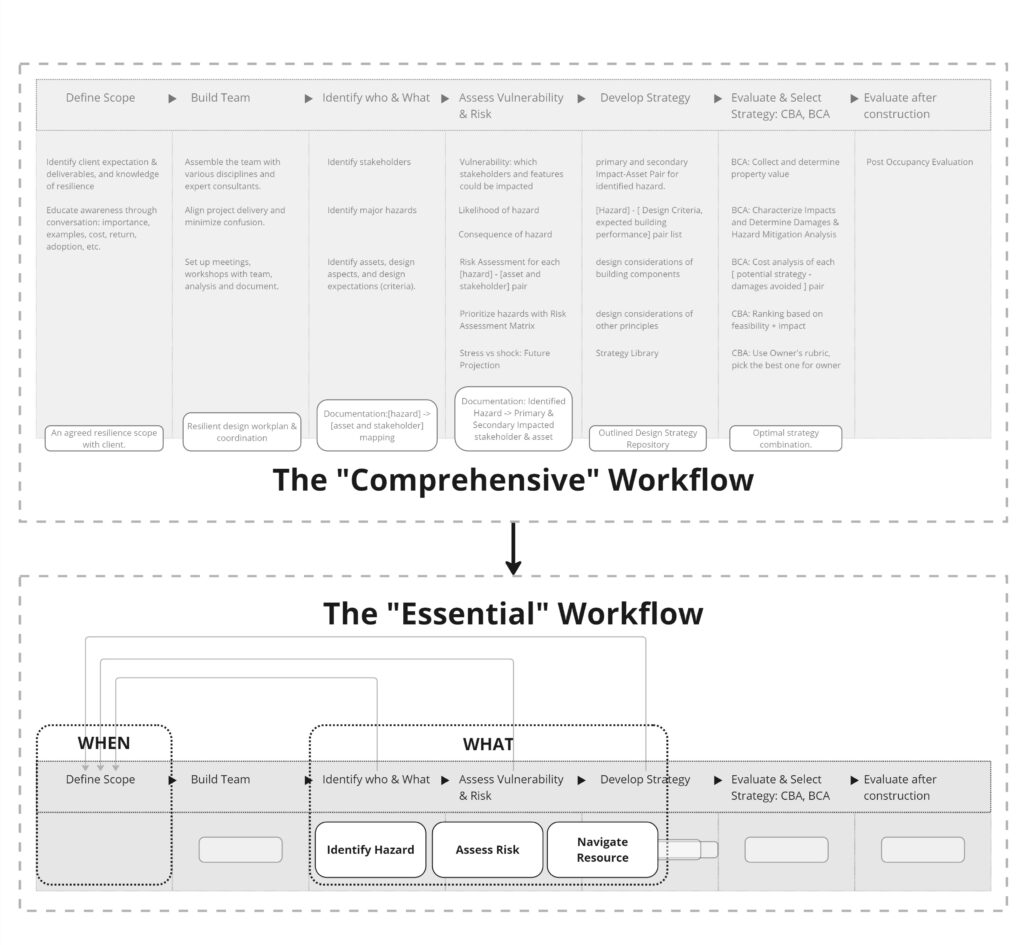
This diagram consolidates tasks from leading frameworks—the AIA-HKS Resilience Design Toolkit, the U.S. Climate Resilience Toolkit, Vancouver’s Building-Resilience Worksheet, and other practice examples—into a seven-stage comprehensive workflow. YONGQUIN ZHAO
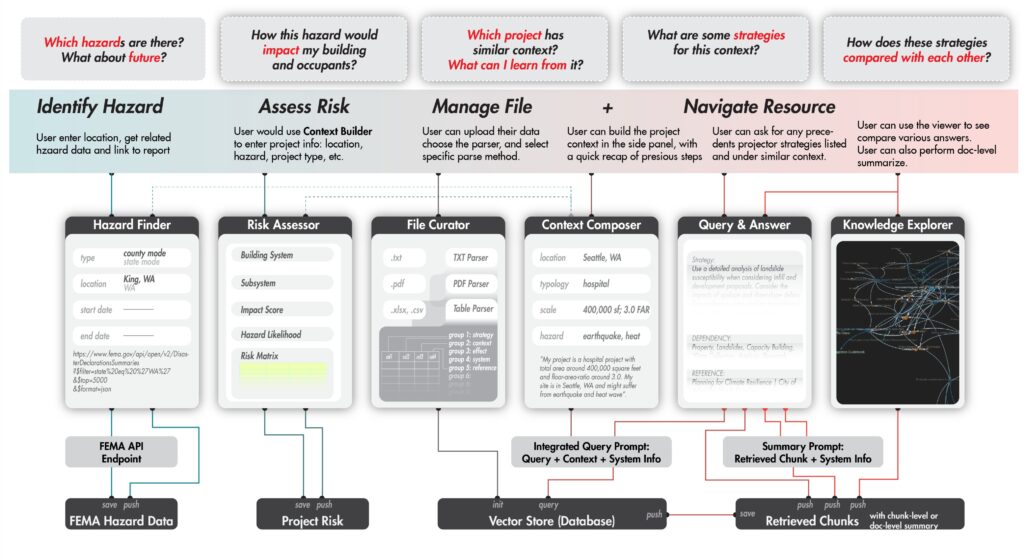
Component architecture aligned with the essential workflow backed by a dedicated modules. YONGQUIN ZHAO
